

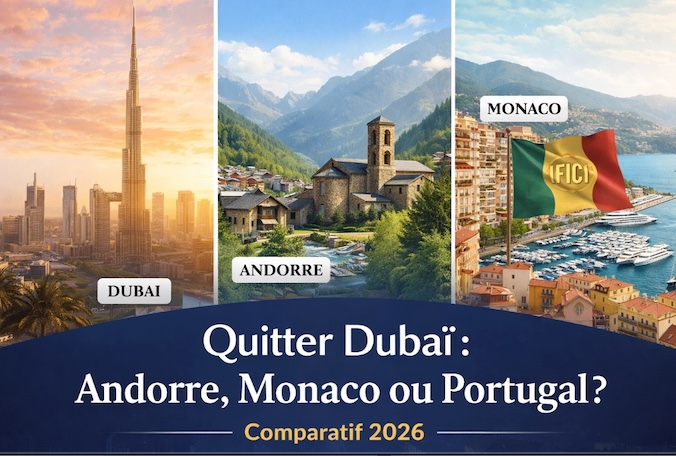

Leaving Dubai: Andorra, Monaco, or Portugal?
A comprehensive comparison of the 4 destinations in 2026
Update 2026: Portugal’s NHR program officially closed to new applicants on March 31, 2025. It has been replaced by the IFICI—a much more restrictive program targeting only qualified professionals in research and innovation. For the vast majority of expatriates leaving Dubai, Portugal is no longer a viable tax option in 2026.
You’ve built your wealth in Dubai. The landscape has changed—with a 9% corporate tax rate, annual residency costs ranging from €60,000 to €100,000, and separation from family—and you’re considering relocating to Europe. Andorra, Monaco, and Portugal: three destinations often mentioned but rarely rigorously compared, whose rules have changed significantly since 2024. This guide puts an end to vague comparisons and evaluates the four jurisdictions based on the criteria that truly matter in 2026.
Your situation deserves a tailored analysis
Wealth, corporate structures, family composition, succession goals: every situation is unique. Our experts help you identify the best strategy—and put it into action.
Get a personalized analysis of my situationFar from Europe
,900 days/year · Permanent
,183 days/year · Extremely high cost
Skilled workers · 10 years max
Why comparison shopping changed dramatically in 2026
In 2022, the tax differential between Dubai (0% corporate tax, 0% income tax) and European destinations was significant enough to justify moving to the UAE despite the distance. That differential has collapsed on two fronts simultaneously.
In Dubai: The 9% corporate tax rate introduced in June 2023 has reduced the corporate tax advantage to almost nothing compared to Andorra or Monaco. Economic substance requirements in free zones have increased annual costs by €60,000 to €100,000. And the French and Spanish tax authorities have stepped up audits of “paper expatriates.”
In Portugal: The NHR scheme, which allowed any foreign resident to benefit from a flat tax rate of 10% to 20% for 10 years, was permanently discontinued on March 31, 2025. Its replacement, the IFICI, is reserved exclusively for highly qualified professionals in research, technology, and innovation—effectively excluding rentiers, investors, retirees, and most entrepreneurs.
In 2026, the choice will therefore boil down to three viable destinations for most high-net-worth individuals leaving Dubai: Andorra, Monaco, and Portugal—where it is essential to understand the new rules first and foremost.
Comparison at a glance — 2026 data
| Criterion | Dubai (UAE) | ★ Andorra | Monaco | Portugal (IFICI) |
|---|---|---|---|---|
| Individual Income Tax | 0 % | 0 to 10% | 0% (except French) | 20% flat rate (eligible profiles) / progressive scale ≤ 48% (others) |
| Corporate tax | 9% (over €93,500) | 10 % | 0% (residents, excluding FR activities) | 21% standard |
| VAT / Indirect Taxation | 5% (VAT) | 4.5% (IGI) | 0% (Monaco) | 23 % |
| Wealth tax | None | None | None | None |
| Inheritance tax | Very limited | None available | None available | 10% income tax on real estate |
| Tax Treaty (France) | None | Yes — signed 2022 | Yes — 1963 treaty (unfavorable to the French) | Yes |
| Minimum attendance required | Visa / Activity | 90 days per year (secondary residence) | 183 days/year | 183 days/year |
| Required investment | None | €400,000 – €1 million (passive house) | Purchase price of €1 million or more, or rent of €5,000 or more per month | None |
| Accessibility of the program | Easy | Accessible | Very limited | IFICI: Qualified candidates only (technical, R&D, innovation) |
| Duration of the tax regime | Indefinite (subject to change) | Permanent | Permanent | 10 years maximum |
| Retirees / passive income | Favorable | Favorable — Income tax rate ≤ 10% | Positive (excluding French speakers) | Progressive tax rate ≤ 48% (no further exemptions) |
| Annual material cost | €60,000–€100,000 per year | Minimal | High | Moderate |
| Nearby Europe (by road) | Intercontinental flight | 3 hours from Barcelona | Immediate | Immediate (EU) |
| Regulatory stability | Low (2023 reform) | Very high | High | Low (NHR → IFICI 2024–2025) |
Data updated in April 2026. The Andorra column is highlighted because it corresponds to Engage’s area of expertise. Each financial situation requires a customized analysis.
Detailed analysis of each destination
In 2026, Andorra remains the destination that offers the most advantages simultaneously for the widest range of profiles: a permanent tax regime with no time limit, a minimum stay requirement of just 90 days for passive residency, a fully operational Franco-Andorran tax treaty, and no wealth or inheritance taxes. The corporate tax rate difference with Dubai (1 percentage point) is marginal—but without the €60,000 to €100,000 per year in maintenance costs and without the regulatory instability in the UAE.
- Permanent tax residency — no time limit
- Only 90 days per year for the passive house
- 2022 France-Andorra Agreement — Residency Recognized in France
- No wealth tax or inheritance tax
- IS 10% excluding material costs
- Quality of life in the Alps, safety, trilingual education
- Investment of €400,000–€1 million required (passive residence) — but it’s an investment
- No international airport — Barcelona or Toulouse
- The housing market is sometimes tight in certain areas
The 0% income tax rate remains Dubai’s enduring advantage. However, since 2023, the 9% corporate tax rate and economic substance requirements in free zones have reduced the overall appeal for entrepreneurs. For businesses whose operations are actually conducted from Europe, the risk of tax reclassification by French or Spanish authorities has become significant. And the lack of a tax treaty with France remains a major structural drawback.
- 0% income tax — ongoing benefit
- Economic vitality and international network
- No real estate investment required
- Corporate tax rate of 9% since June 2023
- Operating costs: €60,000–100,000 per year (free zones)
- No tax treaty with France
- Risk of reclassification due to non-occupancy
- The cost of living has risen sharply since 2021
- Regional regulatory instability
Monaco is the only destination in Europe that offers a permanent 0% income tax rate—but only for a very specific group of people and at a prohibitive cost. A crucial point for French nationals: the 1963 Franco-Monegasque agreement subjects French citizens who left France after 1957 to French income tax. Monaco is therefore tax-neutral for virtually all French citizens—a fact often overlooked that disqualifies the Principality as a tax optimization solution for this group.
- 0% income tax (excluding French nationals)
- Prestige, security, UHNW network
- Political and regulatory stability
- French nationals subject to French income tax despite their residence (1963 treaty)
- Housing: purchase price of €1 million or more, or rent of €5,000 or more per month
- 183 days per year of mandatory attendance
- Highest cost of living in Europe
- Residency status is difficult to obtain
The Portuguese NHR officially closed on March 31, 2025. Its successor, the IFICI (Tax Incentive for Scientific Research and Innovation), is a radically more restrictive program: it targets only highly qualified individuals working in specific fields (research, technology, innovation, certified startups, and companies exporting more than 50% of their revenue). Retirees, annuitants, passive investors, and “traditional” consultants are no longer eligible. For them, Portugal is switching to a progressive tax scale that can reach 48%.
- 20% flat income tax rate on eligible earned income
- Partial exemption on qualified foreign income
- Quality of life, Lisbon/Porto, affordable
- Tax Treaty with France
- NHR closed — progressive tax scale up to 48%
- Foreign pensions: no more exemptions
- Standard VAT rate of 21%
- The IFICI plan is limited to 10 years
- Regulatory instability (two major reforms in two years)
Which destination is right for you in 2026?
Investor / Wealth Manager
→ AndorraPassive income, dividends, capital gains. The Portugal IFICI is not available for this profile. Monaco is not an option for French nationals. Andorra is the natural choice: income tax ≤ 10%, 90 days/year, permanent residency.
Entrepreneur / Active Executive
→ Andorra10% corporate tax with no payroll taxes, personal income tax ≤ 10%, Andorran tax system as a direct alternative to the Dubai Free Zone. Franco-Andorran agreement for French entrepreneurs.
Retiree / Real Estate Assets
→ AndorraThe Portuguese NHR scheme has been discontinued—pensions are now subject to Portugal’s progressive tax scale, up to 48%. Andorra offers a permanent income tax rate of 0% on income up to €24,000 and 10% on amounts above that threshold.
Non-French UHNW individuals (net worth > €20 million)
→ MonacoPermanent 0% income tax, UHNW network, prestige. The prohibitive entry cost is covered. Note: Not available to French nationals for tax purposes (1963 treaty).
Researcher / Qualified tech professional
→ Portugal IFICIEligibility criteria for IFICI: EQF Level 6 or higher degree; employer must be a certified startup or a company that generates more than 50% of its revenue from exports. 20% income tax rate for 10 years. Plan for exiting the program from the outset.
Family with children
→ AndorraTrilingual education, maximum safety, a peaceful lifestyle, and the mountains. The Principality is the natural choice for a long-term family home with a reasonable cost of living.
Why Andorra is the top choice for most people in 2026
The closure of the Portuguese NHR has made it easier to compare the options. For most high-net-worth individuals leaving Dubai, there are two truly viable tax-efficient destinations remaining: Andorra and Monaco. And of the two, Andorra is accessible where Monaco is not—while offering more favorable tax treatment to French nationals than Monaco can.
A comprehensive and permanent tax system
A 10% income tax rate, a 10% cap on income tax, no wealth tax, no inheritance tax for direct descendants, and a 4.5% general indirect tax. And unlike Portugal’s IFICI scheme, this regime is not limited to 10 years—it is the Principality’s permanent tax system.
The lowest minimum population in Europe
90 days per year for passive residency. Monaco and Portugal require 183 days. For active professionals and frequent travelers from Dubai, this flexibility is a decisive advantage not found anywhere else in Europe with comparable tax regimes.
The 2022 France-Andorra Agreement — The Decisive Advantage
Since 2022, Andorran tax residency has been fully recognized by the French government. This settles the matter for all French nationals: Monaco is tax-neutral for them (under the 1963 treaty), Portugal’s NHR program no longer exists, and Dubai has no tax treaty. Andorra is the only destination that offers both low taxes AND legal certainty for French nationals.
The most reasonable total cost
Over a five-year period, Andorra is now less expensive than Dubai for comparable assets. The mandatory investment for passive residency (€400,000 to €1 million) generates a return—it is not an expense. The cost of living is 30 to 40% lower than in Dubai. And the 10% income tax rate does not incur any additional holding costs.
How to Successfully Relocate from Dubai to Andorra in 6 Steps
Tax Audit in the UAE
Analyze the specifics of your residence in Dubai—documented days of presence, ties to France or Spain, corporate structures, and the nature of your assets. Identify any remaining risks before taking any action.
Choosing Andorran residency status
Passive residency (90 days/year, investment of €400,000–€1 million), international presence (90 days/year, 85% of income earned outside Andorra), or self-employment (183 days/year). The appropriate status depends on your profile and residency requirements.
Wealth and Corporate Structuring
Establishment of an Andorran limited liability company (SL) as the parent holding company, or partial retention of foreign structures. Alignment of dividend flows and governance with the new tax framework.
Liquidation or reorganization of Dubai-based entities
Dissolution of the free zone company (3 to 6 months), repatriation of capital, and closing of accounts. Anticipate withholding taxes and prepare documentation tracking the funds’ origin for Andorran banks.
Opening a Bank Account and Investing in Andorra
Conduct rigorous due diligence (Creand, Andbank, MoraBanc) on capital inflows from the United Arab Emirates. Prepare a comprehensive source-of-funds documentation package. Make the investment in Andorran assets within six months of submitting the residency application.
Submission of the residency application and NIA
Application submitted to the Andorran Immigration Service. Issuance of the NIA (Administrative Identification Number). Total processing time: 6 to 12 months. It is essential to plan ahead.
Andorra: A Stable Legal System While Others Are Reforming
The key lesson from the years 2023–2025 is this: jurisdictions that once seemed the most attractive have reformed their tax regimes under budgetary or political pressure. Dubai introduced a corporate tax within a few months. Portugal abolished the NHR within a year. These reforms are no accident—they reveal the fragility of regimes built on politically contentious tax exemptions.
Andorra has not undergone this type of reform. Its tax system is not a temporary "exception"—it is the permanent tax structure of a sovereign state with 77,000 inhabitants that faces no internal political pressure to raise taxes. The 2022 Franco-Andorran agreement and compliance with OECD, CRS, and FATCA standards reinforce this predictability over the long term.
True tax luxury isn't a zero tax rate. It's twenty years of predictability.
We assist clients from Dubai, Monaco, and—since the closure of the NHR—former Portuguese residents seeking a long-term alternative. In every case, the process begins with the same initial assessment: understanding the reality of your situation before committing to anything. Our team is well-versed in the specificities of each jurisdiction and works with you to develop the strategy best suited to your profile.
Which destination is right for you in 2026?
Andorra, Monaco, or Portugal IFICI: the right choice depends on your assets, your business, your nationality, and your goals. Our experts will analyze your situation and work with you to develop the optimal strategy.
Schedule an appointment with an expertFAQ — Comparison of Dubai, Andorra, Monaco, and Portugal in 2026
Will the Portuguese NHR still exist in 2026?
No. The NHR program officially closed to new applicants on March 31, 2025. Its replacement, the IFICI, is reserved for highly qualified professionals working in research, technology, or innovation within certified entities (startups, companies exporting more than 50% of their revenue, R&D centers). Annuity recipients, investors, retirees, and “traditional” consultants are no longer eligible and will be subject to Portugal’s progressive tax scale (up to 48%).
Is Monaco a real option for a French person leaving Dubai?
No, in almost all cases. The 1963 Franco-Monegasque agreement subjects French nationals who left France after 1957 to French income tax, regardless of their residence in Monaco. The Principality is therefore tax-neutral for French citizens—and its prohibitive cost of living (housing, daily expenses) makes it inaccessible to most people.
Is Andorra really better than Dubai in 2026?
For most people, yes. The difference in corporate tax rates is just one percentage point (10% vs. 9%). But Andorra imposes no residency costs (€60–100k/year in Dubai), offers a tax treaty with France (which does not exist in Dubai), passive residency requiring only 90 days of presence per year, a cost of living that is 30–40% lower, and regulatory stability that Dubai has lost since 2023.
Is it possible to hold both Andorran residency and interests in France?
Yes, under certain conditions. The 2022 Franco-Andorran agreement clearly defines the criteria for tax residency. It is possible to maintain a second home, real estate investments, or equity interests in French companies—but Andorran tax residency must be genuine and documented (actual presence, permanent residence, and center of vital interests in Andorra).
Is my profile eligible for the Portuguese IFICI?
The IFICI is available only to individuals who have not been tax residents of Portugal in the previous five years, who work in a qualifying field (research, technology, innovation), and whose employer is a certified startup, a recognized R&D center, or a company that generates more than 50% of its revenue from exports. Simple consultants, investors, or remote workers without an eligible Portuguese entity are generally not eligible.
How long will the transition from Dubai to Andorra take in 2026?
Between 6 and 12 months: liquidation of the free zone company (3 to 6 months), opening an Andorran bank account (4 to 8 weeks), completion of the mandatory investment, and submission of the residency application (2 to 4 months for processing). It is strongly recommended to plan ahead by 12 months to avoid any period of tax uncertainty.

